Shadow Alchemy: When Shadow Work Isn't Enough

I remember a time when I thought I was doing a really good job at healing. I had learned the communication tools. I had mapped out a lot of my trauma and the reactions and experiences that came with it. I had insight. I had intention. I had my shit together.
Then I got into a relationship. A safe, healthy relationship. And suddenly all those things I thought I knew took a backseat to all the intelligent, maddening ways my body had learned to protect me through a lifetime of abandonment.
For a minute there (and even sometimes still) it felt like everything I had worked so hard to stabilize went directly out the window. Like all the tools, language, insight, and intention I had gathered somehow evaporated the minute safety and intimacy coexisted in a way my system could respond to. But that’s not the case. And when I’m not eyeball deep in my own reactions, I remember that my body reacts much faster than my mind, and no amount of self-awareness could have short-circuited that response.
What was coming up for me wasn’t some big failure on my part, but rather an important part of an alchemical process; an unfolding of deeper layers of healing. See, the material that was surfacing was only surfacing because the conditions had changed. I was dating someone who was available, and the truth was: it felt so safe that I was terrified. This level of safety was unfamiliar. My system had learned how to survive uncertainty, distance, and disappearance. Abandonment I knew. What I did not know was mature romantic love that stayed. This was the doorway.
This is where shadow alchemy begins. When what has been protecting us is finally touched by enough safety to loosen its grip, and when we are willing to stay with what emerges, rather than override it with insight.
Sometimes it happens in relationships (this means friendships, too!) Sometimes it happens in the therapy room, and sometimes it happens along our own healing journey.
It’s not us integrating “bad” parts, and definitely not us fixing broken ones. But rather, us coming into contact with the intelligent strategies (patterns, reactions, etc) our body has built to survive and creating space for them to reveal their function once the conditions that required them have changed— so that agency can return.
Why Shadow Work Sometimes Isn’t Enough
Shadow work is a great starting point. And it’s where we start with Shadow Alchemy as well. You learn to name patterns. You understand where reactions come from. You reclaim parts of yourself that were once pushed out of awareness. But if you stop there, you can still feel stuck.
Especially in moments of increased activation, insight alone often can’t keep up with what the body is holding. You may know why you react the way you do and still feel hijacked in the moment. You may have language, context, and compassion and still feel caught in the same cycles.
This is because Shadow Work wasn’t designed to bridge between intellect and nervous system. For healing to reach the level of lived relationship, behavior, and capacity, a different kind of process is required, one that works with how protection is held in the body, not just how it’s understood in the mind.
Shadow Work, Evolved
So, you might be reading this thinking ‘How is shadow alchemy different from shadow work’ The example I opened with is where shadow work and shadow alchemy begin to diverge.
Here’s the short answer (the rest of this piece is the long one):
Traditional shadow work brings unconscious content into awareness—emotions, traits, memories, and parts of ourselves we’ve pushed out of view. We cognitively understand what it is and why it is.
Shadow alchemy works with the strategies beneath those parts (the patterns and nervous system responses that formed to protect us) and allows them to loosen and reorganize once safety makes them unnecessary.
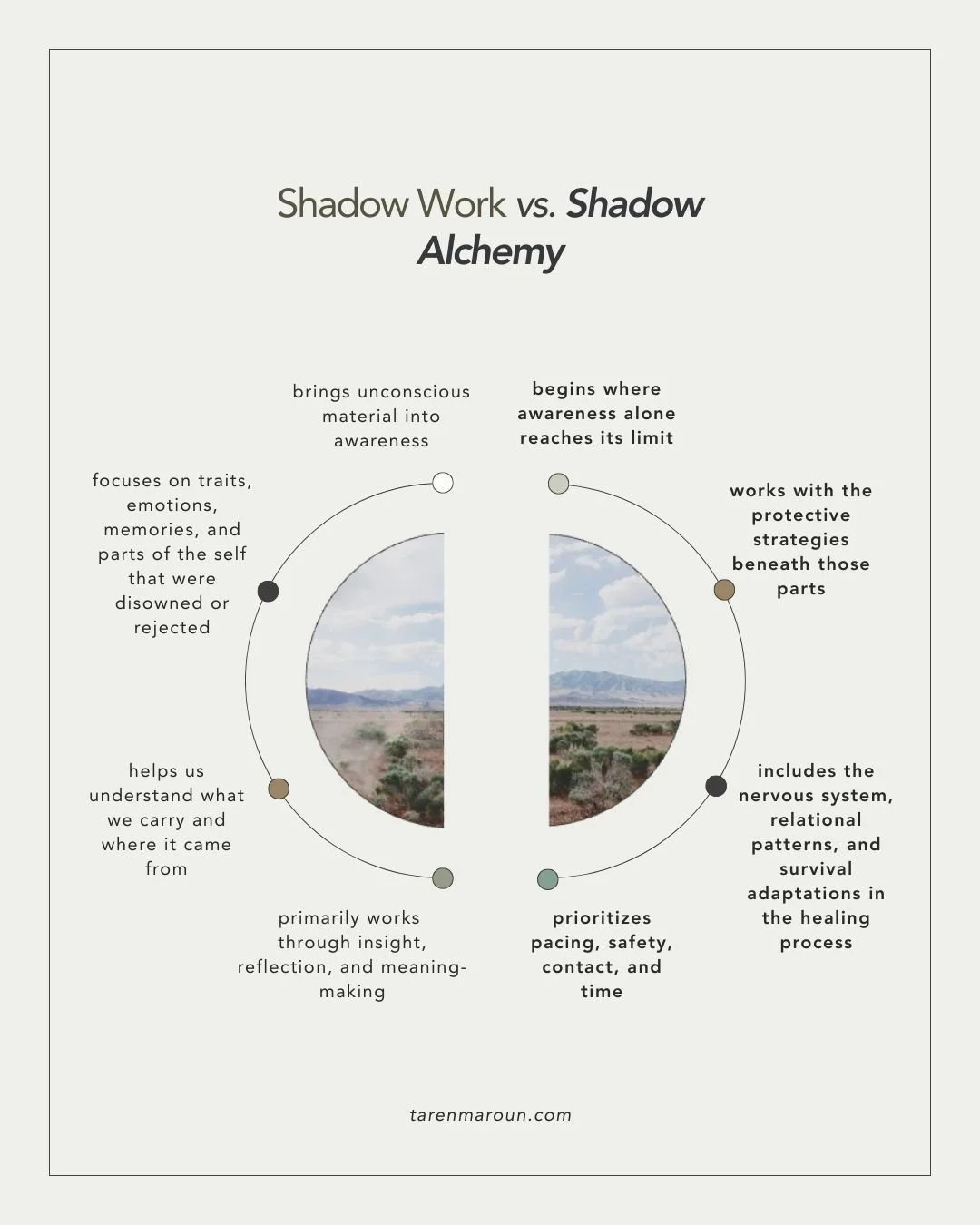
What I know from working with the nervous system and trauma is that insight alone is not enough to transform what has been living in the body. Simply knowing about (and understanding where it came from) your anger, your grief, or even your rejected capacity for creativity doesn’t automatically change how your system responds. That’s where shadow alchemy steps in.
Shadow alchemy doesn’t ask only what was disowned. It asks what has been protecting you, and what becomes possible when that protection is finally met with enough safety to loosen its grip.
It’s a subtle but critical shift that is the foundation for transformation.
Shadow Work vs. Shadow Alchemy
Shadow work:
Brings unconscious material into awareness
Focuses on traits, emotions, memories, and parts of the self that were disowned or rejected
Helps us understand what we carry and where it came from
Primarily works through insight, reflection, and meaning-making
Shadow alchemy:
Begins where awareness alone reaches its limit
Works with the protective strategies beneath those parts
Includes nervous system responses, relational patterns, and survival adaptations formed outside conscious choice
Asks not only what is present, but what is protecting
Attends to the conditions required for protection to loosen—pacing, safety, contact, and time
What lives in the shadow isn’t only disowned traits or unacceptable emotions. Often, it’s the intelligent ways we learned to survive. The patterns and nervous system responses that formed quietly, outside of conscious choice, to keep connection, avoid loss, or to keep us alive when it wasn’t safe to be fully seen. These strategies only loosen through contact. Through time. Through repeated experiences of safety that make those protections no longer necessary.
This is why shadow alchemy insists on pacing, containment, nervous system participation, and embodied reorganization. Because the places we react from don’t live only in thought or language, they live in behavior, capacity, and relationship. And it’s there, in lived experience, that real change has to happen.
This is where the work stops being something we understand and becomes something we enter; a sacred process of becoming.
Once the protective strategies have been named the question is no longer what am I seeing? It becomes can I be with what is being asked of me now that I see it?
Knowing what protected you is one thing. Letting it loosen without rushing the process or forcing an outcome is something entirely different.
Descent as Initiation
This is a space we are rarely taught how to inhabit. The moment after what was familiar dissolves, but before what comes next has taken shape. The space between. Between identities. Between stories. Between ways of being. We tend to avoid it as a culture because it isn’t linear. It isn’t efficient. It isn’t clear. But contrary to the way it feels, it isn’t empty either. It’s charged. Alive. Reverberating with potential. Like dark soil, it doesn’t ask for movement, it asks for presence. For the willingness to stay with what is reorganizing.
This is the threshold of initiation, and the beginning of shadow alchemy. A passage that cannot be bypassed, optimized, or reframed away. Something must be endured here. Something must be metabolized. And what is gained is not information or clarity, but a form of knowing that can only be earned through direct contact with what is dissolving.
I’m always reminded of the Phoenix when I think about initiation. Not just as an archetype of resurrection, but as an archetype of consent. The Phoenix does not fall into the fire by accident. It is not pushed. It does not burn because it failed to escape. No, the Phoenix gives itself to the fire. And that is important.
Because initiation is not always self-chosen in its timing, but conscious participation in the collapse encodes the outcome. We don’t decide when the ground gives way beneath us. But we do decide whether we meet the descent with refusal or with presence. Whether we cling to what is already burning, or allow the collapse to do what it does best. Conscious participation in the undoing doesn’t prevent the fire, but it absolutely shapes what survives it.
Understanding the Alchemical Arc
This is something I am so deeply passionate about, and feel is so important to name in the process of healing: Healing is cyclical. And understanding the process through which we move can be supportive to us taking our time and trusting the process. This isn’t work that you do, it’s the work that happens through you when the conditions are right.
Just like alchemy, just like Nature, just like life, healing does not move in a straight line and isn’t void of ups and downs. No. There are phases and each phase offers a certain type of work, which encodes a certain type of outcome (remember the phoenix? How we participate informs the outcome)— and that's not to say you have to do it right, or complete it perfectly, because repetition and resistance are also messages to the process.
In alchemy, these phases were once called Nigredo, Albedo, and Rubedo. Blackening, whitening, reddening. Notably, Nigredo is the longest phase.
Check out the phases below and see if you recognize yourself in any of them:
Nigredo— The Blackening
Breakdown: This is the undoing. The moment when what used to work no longer does. Old identities, strategies, and structures begin to dissolve. This phase often feels like failure, collapse, or regression, but in alchemy, it’s the necessary beginning. Something has to fall apart before it can be transformed.
Disorientation: After the breakdown comes the space between. The not-knowing. The darkness. This is what is sometimes referred to as ‘The Dark Night of the Soul’. This phase includes a loss of orientation. This is where many people rush—toward answers, meaning, or a new identity—because the ambiguity is uncomfortable.
But alchemically, this phase asks for patience. For letting yourself fall apart without immediately rushing to put the pieces back together. If we can allow space and time here, something deeper begins to reorganize beneath the surface. It begs the question, “Can you stay with the discomfort?”Heat / Pressure
This is where intensity often shows up. Emotions surface. Patterns activate. The system feels stretched thin. In alchemy, heat isn’t punishment, it’s what makes transformation possible. But too much heat, too fast, cracks the vessel. This is where containment comes in: Support. Pacing. Enough safety to stay present without overwhelming the system.
Albedo— The Whitening
Distillation: This is where essence begins to clarify. Through staying power, repetition, contact, and time the new form begins to reveal itself. What is false falls away. What is true remains. This is where insight begins to ripen. It’s the bridge between worlds. This phase requires time and space to allow meaning to emerge instead of extracting it prematurely.
Rubedo— The Reddening
Reconstitution: This is the return. Not to who you were, but to life, reorganized. Behavior shifts. Capacity increases. Choice becomes available where compulsion once lived. This phase is where integration drops into embodiment. Letting what has changed actually shape how you live, relate, and move forward. And, it’s not a perfect process. It’s not a one and done. It also requires repetition, time, exposure and patience.
Shadow alchemy draws directly from this lineage as a metaphor for our own healing process and invites us to see each step of the process as vital.
The Gifts of Shadow Alchemy
Why do shadow alchemy? Well, there are a whole host of reasons, but let me lay out some of the main ones for you:
Behaviors shift.
This is where those patterns you’ve been trying to shift begin to do just that. And it’s all because you’ve learned to create safety for yourself, and in that space compulsion loosens. Maybe you pause where you used to react. Or, you feel a sensation rise and it doesn’t immediately hijack your behavior. This is where the gap between unconscious reaction and action widens just enough for embodied agency to arise. Yes, you will still have feelings and you may still get activated. But the behavior that follows will become less and less automatic the more you stay with it.Here, choice becomes available in places that used to feel stuck.
Relational capacity expands.
You can stay longer. Your capacity to remain in contact with discomfort, misunderstanding, and moments where you would have previously disappeared, fused, attacked, or shut down grows. Intimacy begins to feel less immediately threatening to your nervous system, even when it’s still activating. Over time, you may find you don’t have to abandon yourself to stay connected, and you don’t have to abandon connection to regulate. Relationships stop being the place where your deepest wounds run the show, and become a space where repair, pacing, and mutual presence are possible.
Responsibility increases, not decreases.
This is an important distinction. Shadow alchemy does not absolve you of responsibility by explaining your past. It does the opposite. As protection loosens, capacity increases— and with capacity comes responsibility. Responsibility for your impact. Responsibility for your choices. Responsibility for how you show up once you are no longer operating purely from survival. Healing is not about exemption. It is about becoming more able to respond.
Presence deepens.
Your ability to stay here, inside your body, inside the moment, inside complexity. You don’t need to escape discomfort as quickly. You can feel more without fragmenting. Your system has more range. More tolerance. More room to experience life without needing to control it.
Consistency replaces intensity.
You stop relying on crisis to feel alive or connected. Growth stops requiring collapse. Change becomes something that unfolds through repetition, relationship, and time. What emerges is not a peak experience, but a more consistent and reliable one. You show up again. And again. And again because that is the foundation of transformation.
The Nervous System’s Role in Shadow Alchemy
We’ve touched briefly on how important it is to drop this work into our bodies and systems, but I want to give you a bit more insight as to why.
One of the main things I’d love for you to take away from this article is that the nervous system does not reorganize through understanding. I’m really trying to hammer that one home. Instead, it reorganizes through experience. Through repetition. Through pacing. And, through moments of safety that arrive slowly enough to be held without overwhelm.
This is why people can name their patterns and still feel hijacked in real time. Your system is guiding the way (did you know that roughly 80% of the information traveling between the body and brain moves from body to brain, not the other way around?!) and it’s responding to perceived threats faster than your brain—where all that juicy intellect is stored— can.
Shadow alchemy works at this level. It creates the conditions under which protective responses no longer have to fire automatically. Safety here is not a belief or a mindset. It’s a physiological state built over time, in contact, and often in relationship.
When the nervous system is included, change stops relying on effort. What shifts becomes something the body can sustain, not just something the mind understands.
Spiritual Bypassing in Healing Work
I want to be clear about something here, because it can be really easy to miss the point when it comes to this kind of work and stall out. As Mirabai Starr says, sometimes we mistake fireworks for the sun. And while that’s understandable, I’m here to help name some of those fireworks to make your process smoother.
What I want to help you avoid is pain becoming proof, depth becoming performance, or decent becoming your identity rather than a space you move through. I also want to name the urgency that can take hold here. The impulse to resolve, transcend, or make meaning too quickly often leads to spiritual bypassing rather than inhabiting the process, which is what alchemy requires of us.
Intensity alone doesn’t tell us how much transformation is happening. While it can correlate with depth of transformation, it can also signal that the nervous system is totally out of capacity, and reinforce harm instead of healing.
So, let’s not stop there. Let’s not stop with the signal flares, and let’s not drop into the strategies that actually help us avoid the discomfort of transformation. No, we must keep going if we want change to take root.
There are so many doorways into this work: uncertainty, disappointment, longing, conflict, shame, fear, desire, and change— but also safety, intimacy, consistency, responsibility, and the unfamiliar experience of things staying. Sometimes saftey and stability can fee just as triggering as loss or grief. Sometimes it’s the absence of crisis. Sometimes it’s being seen clearly, or having choice where survival once decided for you.
When these moments activate us, alchemy then asks for the often hard and uncomfortable work of staying. It asks us to lay down the glamour of big breakthroughs and bypassing strategies, and to dig our hands into the soil of our becoming.
Alchemy invites the agents of true, sustainable change. It invites containment over overwhelm, presence over urgency. Time and Space. Without pacing, the nervous system stays organized around threat rather than rewiring. Without containment, descent can re-traumatize rather than transform. Time and space create the circumstances within which the psyche can metabolize and integrate what is being learned.
Alchemy doesn't mistake intensity for depth. It insists on something quieter and more demanding: staying with what has surfaced long enough for it to complete its cycle. It does not rush. Instead, it let’s the system learn through repeated, lived experience that what once had to protect you no longer needs to. It requires contact and completion.
This is the heartbeat of transformation.
What Makes Healing Stick
At the end of the day this work isn’t about becoming more aware, more spiritual, or more articulate about your wounds. It’s about becoming more available, to yourself, to the world around you, and to the moment before you. It’s about slowing down and sinking into the process of becoming.
Shadow Alchemy asks us to reframe the way we view our healing journey, and invites us to allow that reframe to inform the process. It invites us to be embodied participants in our own evolution, rather than an intellectual witnesses.
Remember that this work is not a linear process. It’s cyclical and it spirals. It revisits familiar territory from new levels of capacity. It invites us into mastery through repeated exposure. And often, it looks quieter than we expect. Less dramatic. More ordinary. It most often reveals itself through the slow, quiet, consistent work of choosing to show up again and again for the uncomfortable work of un-becoming, first.
Wishing you so much sweetness in your journey~ and remember, If you are ever interested in exploring this work more thoroughly and need a guide, you know where to find me.

Hey! I’m Taren.
& I am so happy you are here.
Briefly: I am a somatic practitioner, trauma alchemist, and writer who helps people navigate the thresholds of identity, healing, and personal transformation. With a background in depth-oriented psychology, nervous system work, and mythic storytelling, I support clients through the liminal seasons of their lives— the unravelings, the initiations, and the slow rebuilding of self. My work sits at the intersection of the body, the psyche and the unseen forces that shape our ultimate becoming.
If you are in the middle of your process, feeling like a little support might be nice, reach out. I’d be honored to walk alongside you.